

The Zion Mule Corps were founded in Alexandria, Egypt and sworn into the British army on the first working day after the Pesach Seder in 1915.
The Chief Rabbi of the city attended the ceremony and noted its connection to the biblical exodus from Egypt, hoping these soldiers were setting out to reconquer the Promised Land.
Among the thousands of Jews who had been expelled from Palestine to Egypt by the Ottoman Empire were Zionist leaders Ze’ev Jabotinsky and Joseph Trumpeldor.
Jabotinsky was also inspired by an opportunity to join the Allied Army during WWI as a way to gain support for a Jewish homeland in Palestine.
However, although the British rejected a full combat Jewish legion, they did approve a transport unit delivering ammunition, food and other supplies to the front lines during the Gallipoli campaign.
The Gallipoli Peninsula terrain was difficult and the Jewish transport legion was consigned to operate in areas where motor transport was impossible.
This led to the formation of the Zion Mule Corps, which is historically significant as the first purely Jewish fighting corps to go into action since ancient times, on this occasion armed with mules.
It lay the groundwork for later Jewish active fighting forces like the Jewish Legion and ultimately the Israel Defence Forces.
After just three weeks of active training in Egypt, 700 Jewish volunteers set sail for Gallipoli under the command of Lieutenant Colonel John Henry Patterson, an Irish Catholic, and Joseph Trumpeldor.
Trumpeldor had previous experience as one of the few Jewish officers in the Russian army and a veteran of the Russo-Japanese war.
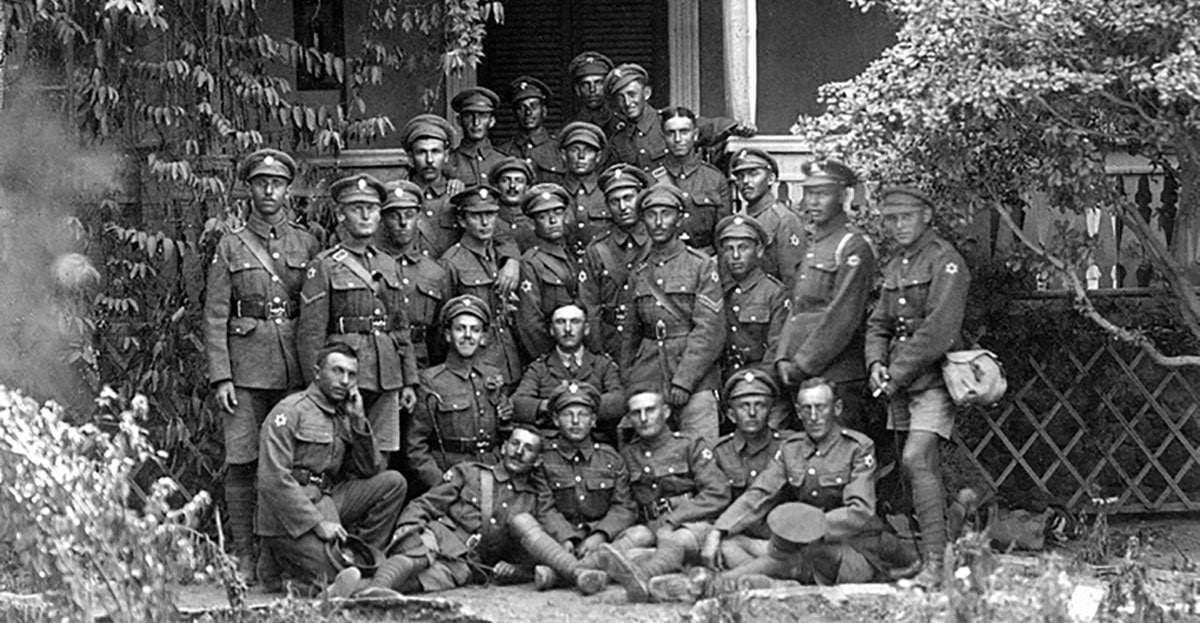
The men of the Zion Mule Corps were accompanied by 750 pack mules, each fitted with wooden carriers designed to hold heavy loads.
The transport unit disembarked at the Gallipoli Peninsula in pouring rain, leading the terrified mules up a cliff above the beachhead carrying their first convoy of supplies.
For months they carted food and ammunition through mud and heavy fire until in December 1915 the British decided to evacuate.
By then the mule drivers’ bravery was an accepted fact.
One British officer noted their skills in handling mules while working under heavy shell and rifle fire.
Private Grouschkowsky was awarded a Distinguished Conduct medal for preventing his mules from stampeding during a heavy bombardment and delivering ammunition, despite being wounded in both arms.
It is worth noting that at a similar time to the Zion Mule Corps landing at the Gallipoli Peninsula, the Australian and New Zealand Army Corps, (ANZACS) made their first major WWI engagement at the Gallipoli cliffs.
The ANZACS helped to forge a national identity around bravery, endurance and mateship but suffered heavy casualties. More than 7,500 dead.
Bravery Award
Just one year later, following heavy casualties in France and a severe lack of recruits, the British started to rethink their opposition to a Jewish combat unit and called Jabotinsky for support.
In no time Jabotinsky recruited throughout the Jewish world, starting in London and including Palestine where the British were planning to advance.
The first to enlist were the 120 men of the Zion Mule Corps with Patterson returning as their head.
Each of these three Jewish battalions wore a coloured Star of David armband.
To this day, 100 years later, the Jewish Mule Corps, then the Jewish Legion and now the Israeli Defence Forces, have been blessed with the ability to fight with bravery in the face of terrorism and warfare.