

In 1923, celebrated Israeli poetess Rachel Bluwstein wrote the beautifully moving poem ‘V’ulai’ which has become one of Israel’s most beloved folk songs.
Oh my Kinneret
Did you exist?
Or did I dream a dream?
At the time she penned the poem, she was lying in a couped up small single room apartment near Tel Aviv suffering from tuberculosis which later claimed her life.
Rachel loved the land where she spent her life from 1909 to 1913 on Kibbutz Degania as a pioneer farmer, also gazing across at the beautiful Kinneret (Sea of Galilee).
In addition to learning about soil management on the kibbutz, she traveled to Paris to study agronomy.
Her love of the land became a theme of her beautiful and simply constructed poems.
Her creative skills have left an indelible mark on Israel’s early folklore, when pioneering and tilling the soil was a way of life for dedicated Zionists determined to build a country where Jews could live together in freedom and comfort.
To be chosen for your portrait to be highlighted on a banknote is quite a significant measure of recognition, more often awarded to politicians and other leaders of society.
So why did the Bank of Israel choose the celebrated poetess Rachel Bluwstein to be featured on the current 20 shekel banknote?
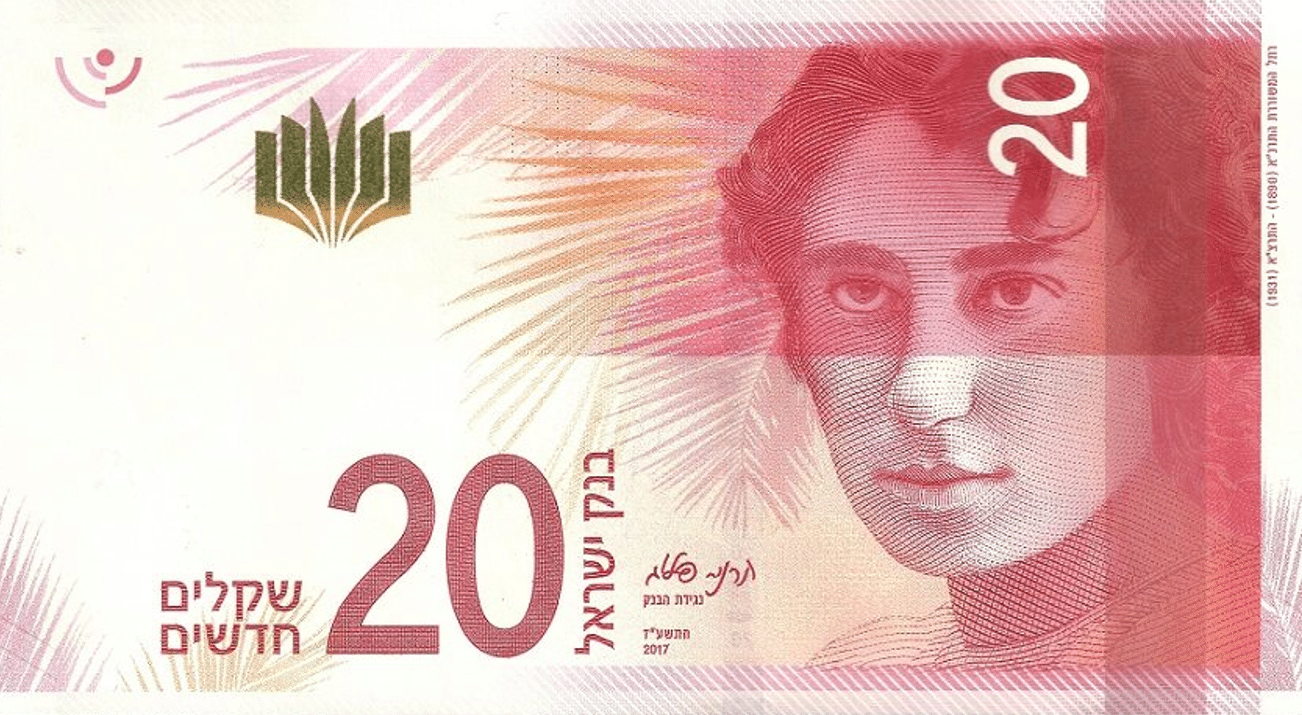
“To help instill in the younger generation of Israel an appreciation of their contribution to Israel society and to the State.”
Perhaps simplicity is a highly suitable and recognizable description of Rachel Bluwstein’s poetry.
Whereas poetry is often the language of flowery expression, sometimes composed with words seldom used in everyday conversation, Rachel’s poems were written in simple modern Hebrew with greater emphasis on an intellectual approach.
In one sense, a feeling of warmth for the Zionist ideal, where the beauty of the emerging state has become a feature of modern Israel.
Where gardens and nature parks have grown out of a barren desert, neglected for thousands of years by nomadic tribes.
Creativity and Sadness
Rachel’s most fruitful and productive poetry was written between 1923 and 1931, at the time when terminal sickness started to govern her life.
She dreamed of happier days on the kibbutz overlooking the Kinneret and the pleasures of a simple but hard-working life.
Fulfilling her Zionist dreams of harvesting the neglected desert.
Despite her moving poetry, the critics seldom agreed, claiming she had limited artistic ability.
However, we should look more introspectively into this claim.
A young women awaiting an untimely death and feeling the insignificance of a sick woman in a world that revered strength and power.
At a time when her body was suffering, her inspiring and meaningful poetry has won the hearts of thousands of people.
So many of her poems have been set to music and so many women have been emotionally moved by her heartfelt poetry.
During the time of the British Mandate of Palestine, the composition of Hebrew poetry was basically male-dominated.
Rachel Bluwstein’s poetic prowess has rightfully earned her the title “The Founding Mother of Hebrew Poetry for Women.”