

Histories of the Holocaust rarely mention Sephardic Jews, while there is even less Ladino music preserved and recorded compared to that of Yiddish, German and Polish songs composed to perpetuate the memory of the tragic Jewish experience.
However, there are a handful of Sephardic songs written in Ladino by Sephardic Jews living in the United States that are remembrances of the Holocaust.
One of them was written by the famous Sephardic musician Flory Jagoda (1921-2021) who wrote a beautiful version of a song which she titled ‘Farewell Beloved’.
Her Story is One of Survival and Achievement
Flora Papo was born to a Jewish family that had migrated from Turkey to Sarajevo.
In 1941, to escape the Nazi invasion, her Croatian stepfather gave her false papers to catch a train to the southern half of Croatia which was a Catholic state gifted by Germany to Italy.
Flora was a musician and during the long journey played her accordion continuously to avoid having her false papers questioned.
Her mother and stepfather joined her 4 days later, but then the Italians moved the family to a Croatian island for internment.
They remained there until 1943 when Italy capitulated to Germany and Croatia became a puppet-state occupied by both enemy powers.
Luckily, the family managed to board a fishing tug that took them to the town of Bari in southern Italy where they were welcomed as refugees.
Flora found employment in Bari where she met an American soldier.
Later they were married and moved to the United States where she became a popular artist and changed her name to Flory Jagoda.
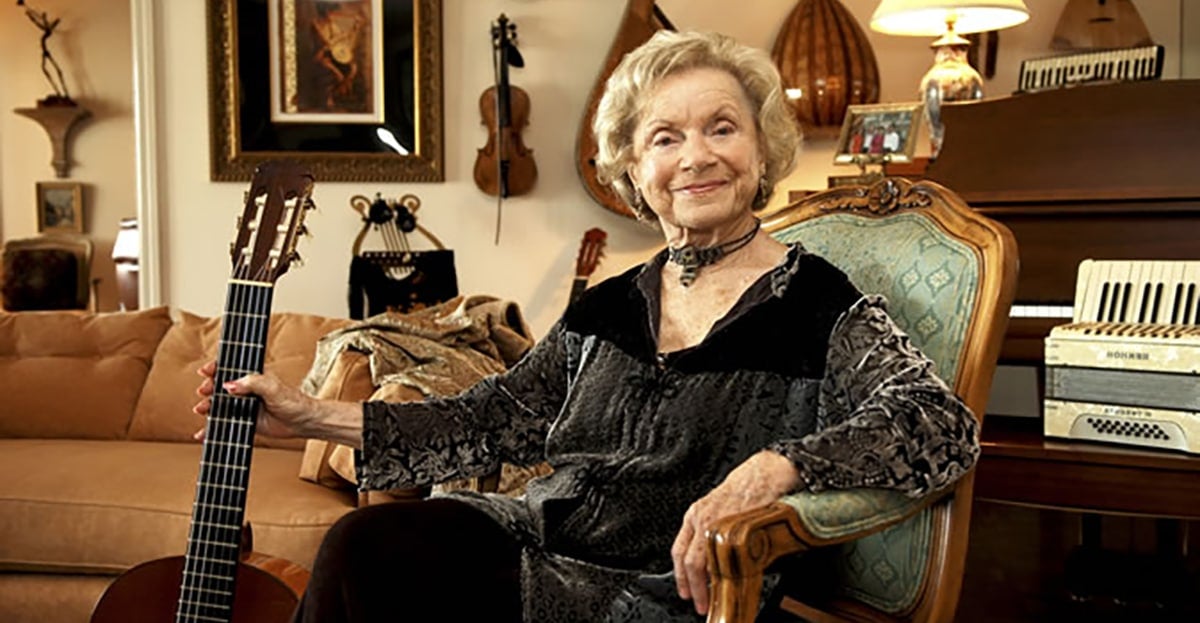
An Instrumental Change
Although Flory was an accomplished accordianist playing music with a traditional Balkan sound, she changed to a guitarist to make her music more appealing and interesting to young American audiences.
Since that time Flory was later celebrated as a National Heritage Fellow.
This award is recognition to an artist for their excellence and contribution to the nation’s folk and traditional arts heritage.
It is the highest honour in the United States for artistic excellence.
Her version of the song ‘Adiyo Kerida’ written in 1989 is popularly depicted as being about the Holocaust. In her songbook, Jagoda wrote:
“Modern interpretations of this song have changed it from what I remember from the 1940s when this was the most loved song in Balkan countries, the hottest tango in town.”
Farewell Beloved
When your mother bore you
And brought you into the world
She gave you no heart
To love another.
Farewell, farewell beloved
I no longer wish to live
You made life bitter for me.
Go and look for another love
Knock on other doors
Wait for other ardor
Because you are dead to me.
The melody has classical attributes as well, and opera lovers will certainly know the melody.
Giuseppe Verdi incorporated it into his opera ‘La Traviata’ as Violetta’s aria “Addio del pasatta”.
It begs the question as to whether Verdi borrowed the melody from the early folk song in the Balkans which later became the hottest tango in town, or the other way round.