
Anthony Albanese is right about one thing: what happened at Bondi was “an act of evil” and a terrorist attack that struck at the heart of the country.
He has called it “outrageous” and promised “immediate action” on gun laws. But if all we do now is fiddle with numbers on a firearms licence, we will have understood nothing about what really changed on that beach.
The National Cabinet in Australia rushed out a package to “strengthen Australia’s gun laws”: cracking down on 3D‑printed weapons, tightening imports, a faster national firearms register, stricter controls on high‑capacity magazines, and a limit on how many guns one person can legally own.
We are told the government is prepared to take “whatever action is necessary” and that gun licences shouldn’t be “in perpetuity” because people can be radicalised over time. All of that is sensible. All of it is needed. And yet, viewed from the Jewish side of the police tape, it feels painfully small.
Because here is the brutal fact: a man in suburban Sydney lawfully held six registered guns. Six. This is in the country that still dines out on its Port Arthur story, on how John Howard “fixed” the gun problem. Now, after an antisemitic massacre at a Chanukah gathering, one of the bright ideas being floated is to reduce the cap from six guns to four. As if that is the moral line. As if four guns in the hands of the wrong person is somehow reassuring.
If that is our answer, we are lost.
Yes, gun laws matter. They always have. The 1996 reforms did reduce mass shootings, and a proper national firearms register is long overdue. Australia should be pushing towards the strictest standards in the democratic world, not inching towards them. The default for semi‑automatics and high‑risk weapons should be zero. Licences should be hard to get, tightly time‑limited and easily revoked. If there is any credible sign of radicalisation or violent extremism, the licence should disappear faster than the press conferences.
But from here in the Jewish community, it is impossible to pretend that this is just about steel and plastic. Guns are the last link in a chain that starts a long way upstream.
Where does that chain begin?
I think, with education.
The two men who walked into that Chanukah event with hatred in their hearts.
Those two men did not begin their journey with a Form 1 firearms application.
They began with stories. With sermons, YouTube videos, WhatsApp chats, social media feeds. With what they were told about Jews, Israel, “the West”, probably long before they could spell “licence”.
If schools – state, independent and faith‑based – are funded by the public, they owe the public something back.
Not surveillance, not thought‑policing, but a minimum baseline: that what is taught is consistent with Australian law and with a human‑rights understanding of equality and dignity, including for Jews. If we are so terrified of being called racist that we stop asking what children are being taught, we hand the microphone to the loudest ideologue in the room.
This is not about demonising one community or one kind of school. It is about saying plainly that public money comes with public responsibilities. A curriculum that teaches contempt for Jews, or quietly normalises the idea that Jewish civilians are fair game, should be as unacceptable as one that excuses any other form of racist violence. If we can’t say that out loud, what have we become?
Then there is enforcement.
Antisemitism did not arrive in Australia on the night of the Bondi attack. It has been building.
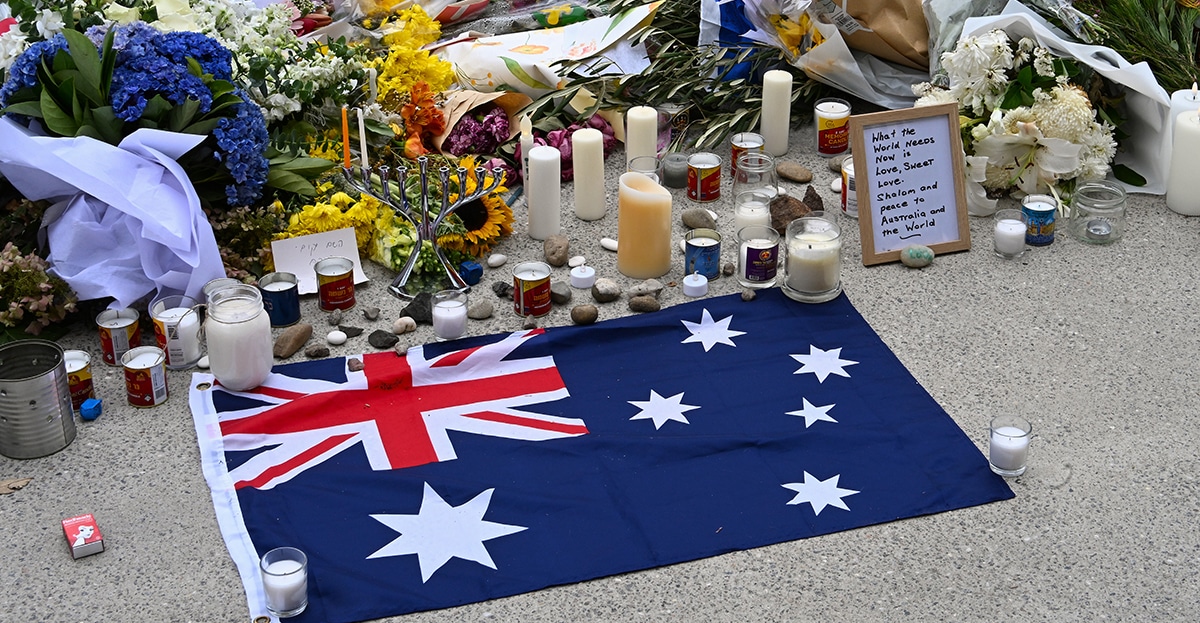
Jewish students pushed to the edge of campuses. Rallies where slogans blur the line between “anti‑Zionist” and “anti‑Jewish”. Online campaigns naming and shaming Jews in public life. Community leaders have been warning, pleading, explaining that “things cannot just go back to normal”, long before the rest of the country noticed. The response has mostly been statements, inquiries, more education sessions for the already‑convinced.
If the state is serious about “eradicating antisemitism”, as the Prime Minister now says, then some hard choices follow. Laws on incitement and harassment must actually be used. Police need the training – and the political backing – to act when demonstrations cross the line into open intimidation of Jews. If existing laws are too weak, then they must be changed. Otherwise “never again” becomes “until next time”.
There is also a third, uncomfortable piece: immigration and citizenship.
Australia has every right, like any country, to decide who it admits and on what terms. A passport and a citizenship certificate are not just pieces of paper; they are a promise of loyalty and a share in the national home. That does not mean turning “migrant” or “Muslim” into dirty words. It does mean stop pretending that there is no link at all between who we let in, how we screen for violent ideologies, and what eventually happens on our streets.
Citizenship should be something earned over time – through obeying the law, contributing, showing that you can live alongside people who are not like you. If someone who has been given that gift turns around and uses it to attack Jews, there should be no ambiguity about where the state stands. Status can be stripped. Assets can help compensate victims. The message must be clear: this country will protect its Jewish citizens first, not those who seek to murder them.
None of this replaces tougher gun laws. We need both: the practical levers that make it harder to kill, and the deeper work that makes fewer people want to.
As I write this, it is the second‑last day of Chanukah, the festival of light. This year, the darkness has felt very close. Candles on Bondi Beach became targets. Families went out for doughnuts and songs and came home – if they came home at all – to a country that no longer feels the same.
But the point of Chanukah is that a small, stubborn light keeps burning when logic says it shouldn’t. For Jews in Australia, and for those watching from Israel and elsewhere, that light is not just a metaphor. It has to show up in the laws we pass, the children we teach, the people we welcome and the lines we draw and enforce.
If the only lesson our leaders take from Bondi is “four guns instead of six”, we will have betrayed that light. If we demand more – in law, in education, in courage – then perhaps the next time Jews gather by the water to sing about miracles, the only thing they will have to worry about is the wind blowing out the candles.
Sharonne Tidhar is a writer, author of two books, and editor of three Australian journals. She makes a habit of getting lost on purpose in new places just to see what she’ll discover, is always looking for new and unusual snacks in the supermarket, and somehow ends up with an unruly stash of chocolate wherever she goes.
Israellycool needs reader support to continue our impactful work. Click on below to donate.