

Today, Israel’s army is often referred to as one of the finest in the world.
It didn’t just happen, it was more an evolution based on necessity and experience.
Having survived the War of Independence in 1948, the success of the Sinai Campaign in 1956, and the truly remarkable victory in the 1967 Six-Day War, Israel faced a decided call-to-arms in 1973.
Drastic improvements were sorely needed in the Israel Defense Forces after miraculously surviving the surprise Yom Kippur War in 1973.
During the war, nearly 3000 soldiers were killed and 8000 wounded.
The IDF lost nearly one-fifth of its air force and more than a thousand tanks.
It was abundantly clear Israel needed to rethink its military operations for continued survival, the principle being that the IDF had to be far ahead of its enemies in quality as it could never challenge them in quantity.
Ben Gurion had repeatedly remarked that the IDF had no choice but to constantly acquire the qualitative edge over its opposition, but on occasion, continued success can lead to complacency.
This is evidently what happened in the Yom Kippur War.
A Hero of Earlier Times
One of Israel’s most distinguished heroes of those earlier times was Rafael Eitan.
Rafael Eitan began his impressive military career at the age of 16 years as part of the Palmach. This was the elite combined strike forces of the Haganah, the main paramilitary organisation of the pre-1948 Jewish community during the period of the British Mandate in Palestine.
During his career he helped to found the IDF’s Paratroopers Brigade, and in 1956 served as the Commander of the Echis Paratrooper Battalion in its historic landing in the Sinai Campaign.
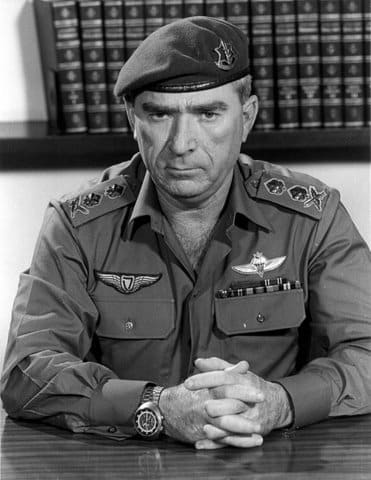
Courtesy IDF Spokesperson’s Unit
As a dedicated soldier proud to serve the Israel Defense Forces, Rafael Eitan was promoted to Commander of the Paratroopers Brigade, then to Chief of the Northern Command.
In 1977, when Menachem Begin was elected Prime Minister ( the first time in the history of modern Israel that a right-wing Likud government was formed), changes were quickly introduced.
Rafael Eitan was appointed IDF Chief of the General Staff.
One of his initial projects was the introduction of the unique Talpiot programme.
Always a believer in advanced education, Eitan recognised this programme which was created by two university professors in Israel had potential benefits for the IDF.
By carefully choosing some of the extraordinary minds of Israel’s brightest youth for developing ground-breaking technology, the Talpiot programme ultimately became one of Israel’s most beneficial military training initiatives.
It is a tough course. Recruits undergo many tests to quality for joining the programme, complete a bachelor’s degree at the Hebrew University while studying special subjects that link the IDF with the latest scientific developments.
After completing 40 months of schooling and training, graduates receive officer ranks and are integrated into the various development and research units of the IDF.
Successful candidates for the Talpiot programme are committed to nearly 10 years of army service.
Learning a Trade
In 1979 Eitan established the visionary IDF Centre for Promoting Special Populations.
The Centre was designed to help Israel’s underprivileged teenagers get an education and to find a trade while serving in the army.
He understood that military service was often the last chance for many teens to pursue a higher education and thus a more successful future.
Lt. General Rafael Eitan followed the values of human dignity, respect and discipline which he instilled in all his soldiers, at every level of achievement.
He was an inspiration to many soldiers and citizens in Israel.