

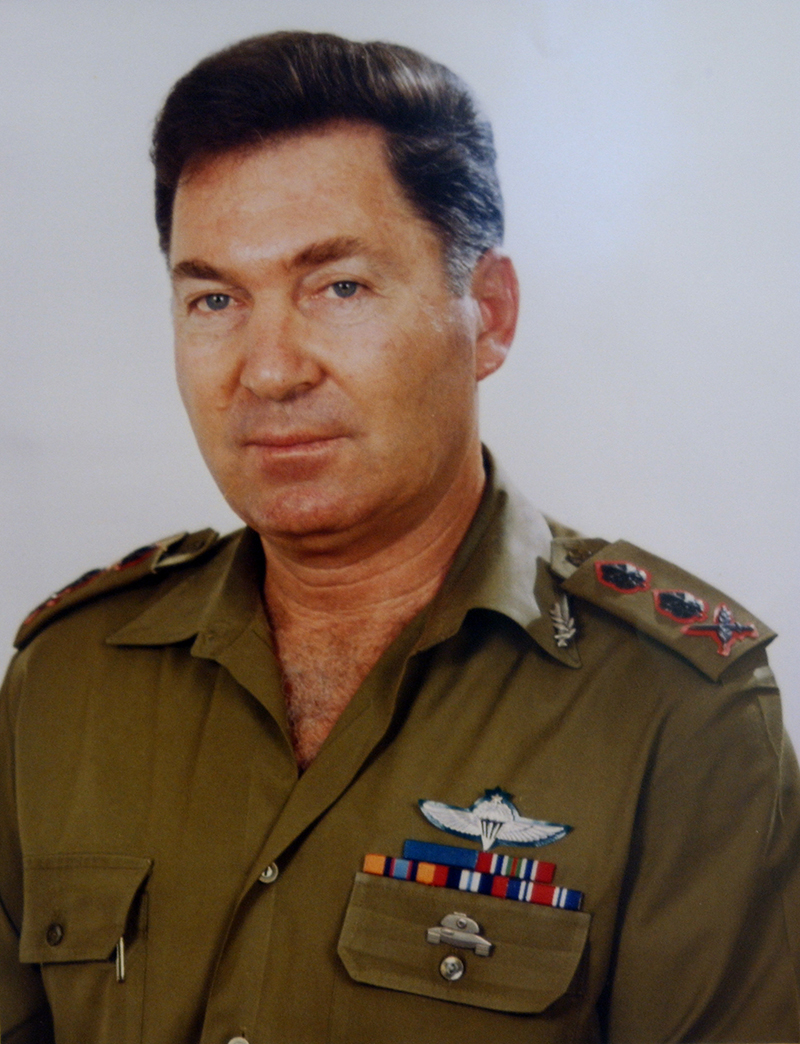
Lt. General Dan Shomron was one of Israel’s highly decorated military officers who served as 13th Chief of Staff of the Israel Defense Forces from 1987 to 1991.
He was widely recognised as a soldier who favoured strategic common sense over political posturing.
In 1976 he was the key figure in the planning and commanding of Operation Entebbe, yet following the overall success of the mission he shunned publicity.
As commanding officer of the campaign he really became an unsung hero as he was such an extremely modest man.
“I felt some kind of envy from the military and it was not comfortable for me. They looked at me as something from a different world, a super-super-hero, something not natural. I don’t like that feeling of being an advertisement.”
In fact, the defining moment of the mission for him was to watch the hostages safely boarding the evacuation plane back to Israel.
Dan Shomron was born on Kibbutz Ashdot Ya’akov in the Jordan Valley and was raised in an environment that valued equality, teamwork and humility over individualism.
A quiet, silent tactician who focused on meticulous planning, right down the smallest detail, aiming to achieve goals with the minimum of casualties, highlighting a sense of responsibility and humanity over military glorification. Unlike some of his contemporaries who were known for aggressive, high-casualty tactics.
True success was a quiet, efficient operation rather than a loud and bloody victory.
Rising from a paratrooper at the age of 18 years to the 13th Chief of Staff of the Israel Defense Forces, his career spanned decades of critical Israeli history, marked by a reputation for quiet leadership and tactical brilliance.
Achievements
Prior to his leadership of the 1976 Operation Entebbe, Dan Shomron played an important role in the 1967 Six-Day War as commander of a unit on the Egyptian front.
He was the first paratrooper to reach the Suez Canal.
In the 1973 Yom Kippur War he led a tank brigade as part of the encirclement of Egypt’s Third Army.
As Chief of Staff he led the IDF during the outbreak of the First Intifada in 1987.
The Key Aspects
Dan Shomron was, in some measure, a unique leader.
Quietly spoken, calm and with complete control, even in the middle of intense operations, his colleagues noted he never showed any signs of panic.
This instilled confidence in his troops.
In addition, with detailed preparation coupled with the element of surprise, he proved an astute leader in battle.
He believed in sound training for his troops to enable them to fight with greater understanding of their mission.
For instance, he even created a replica of the Entebbe Airport as part of their training for this ambition undertaking.
Following his retirement from the IDF he was encouraged to enter politics, but modesty and disinterest in political maneuvering had little appeal as he had a distinct lack of interest in self-promotion.