

We already knew the New York Times was f*cked. But their interview with ex porn star-cum-terror-supporter Mia Khalifa (which is more of a fluff puff piece) takes the cake.
She is almost painted as a martyr:
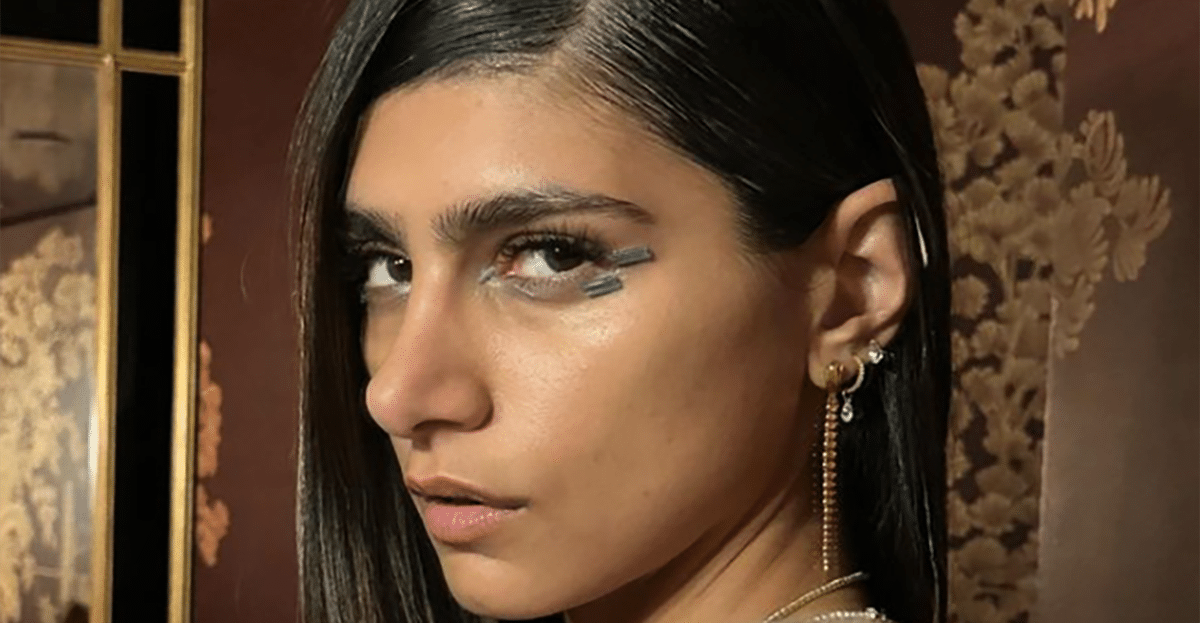
To be influential online is to confront difficult questions about self-presentation, public judgment, freedom of speech, power and money. Over the last decade or so, Mia Khalifa has been forced to try to find some answers.
In 2014, when Khalifa, who was born in Lebanon and raised Catholic in the Washington area, was 21 and working in the adult-film industry, she performed in a sexually explicit scene while wearing a hijab. That scene went viral, and the response was harsh. There were even death threats, including a photoshopped image of her being beheaded by the Islamic State. The vitriol was part of what caused Khalifa to leave the adult-film industry and try to return to anonymity. She couldn’t. Her digital mistake was destined to follow her around.
So a few years ago, Khalifa decided that rather than pretend her past didn’t exist, she could leverage it. She gradually turned herself into a tremendously popular social media influencer, albeit one with a lingering aura of transgression. Khalifa now has millions of accounts following her on X, TikTok and Instagram, where she posts about style, food and, frequently, politics. She has also built a lucrative and impressive audience on OnlyFans, an online platform where subscribers can pay performers directly for content, some of which is fairly innocuous and much of which, including Khalifa’s, is, let’s say, risqué.
I was dimly aware of the controversy surrounding Khalifa back in 2014 and was surprised in recent years to see her popping up here and there — on unofficial online lists of top OnlyFans earners, in a cameo on the great Hulu series “Ramy” and in passing coverage of her jewelry brand, Sheytan.
How did the person I heard about a decade ago turn into the Mia Khalifa of today? That reinvention is part of what I wanted to talk with her about, along with her experience in the sex-work industry and the potential cost to the head and heart of living so unabashedly online.
And true, some of her pro-terrorism tweets are brought up (what the journalist referred to as “living so unabashedly online”). But she is too easily allowed to bat them away, as well as accusations of antisemitism, without any serious grilling or follow-up.
Then last year I saw her name again, this time attached to news stories about her glib and inflammatory tweets following Hamas’s terrorist attack on Israel on Oct. 7, 2023.
—
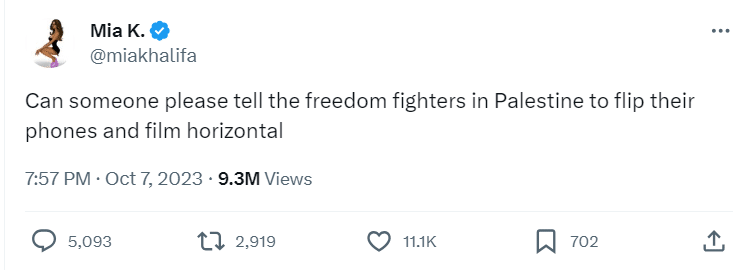
But I’m thinking about how on Oct. 7 of last year you posted on X suggesting the “freedom fighters” in Gaza should flip their phones to horizontal in order to film better. Yeah.
And there was another post of yours on X around the same time where it looked as if there were Hamas militants shooting into an Israeli police car. As a result of those posts, some companies decided to stop doing business with you. I also want to add that you’ve said that while you’re anti-Zionist, you’re in no way anti-Judaism. No, and it’s very important to not say Jewish people when talking about Zionists.
To my mind those posts didn’t meet the moral tenor of the moment. I’m not asking you to defend or explain them, but the question I have is whether your experience with those posts and the reaction they engendered made you think differently about the kinds of posts you want to make about Gaza or about politics? Or really what value you can bring to these conversations? If you’ll allow me, I would like a chance to talk about those tweets. The first one was not — the reason I had said that was because there was a scene that was really poetic and symbolic and beautiful. There was this one scene where a fence was being broken down, and it was civilians, it was children — it felt like the Berlin Wall coming down. That’s what the scene looked like. And that’s why I said “freedom fighters,” because every Palestinian who still has the will to live is a freedom fighter. That’s what it was in reference to. The other one, the photo, it just felt so baroque.
You referred to it as looking like a “Renaissance painting.” Exactly. The composition, everything about it — at the time it was too soon. But I feel like that’s not a radical thing to say about something that looks so — it looked crazy. But, yeah, it was too soon. That’s where I stand on that, and all of the business that I lost because of it was extremely welcomed because if we really disagree at that level, we shouldn’t be working together in the first place. So I’m not angry about it. I’m actually grateful for it. This was the part that I regret the most: It was my intention being so misconstrued that people who were close to me reached out and were deeply hurt by what I had said.
How did they explain their hurt? The same as other people. I cannot believe that you would say something this violently fueled. And having to go back and explain my intention and apologizing for hurting them and really just making sure that they understand who I am as a person.
I think I understand who she is a person, but not from this New York Times PR interview. I understand this because I can think critically.
Her excuse as to why she suggested the “freedom fighters” in Gaza should flip their phones to horizontal in order to film better does not add up. She tweeted this on October 7, when the preponderance of images were of Hamas terrorists committing atrocities.
I do not recall any images of children entering Israel as she claims. Certainly there were no children filming any scenes. And the only civilians who entered that day also committed atrocities and looted from the almost destroyed communities.
This was no “Berlin Wall” scene, but it was something out of Nazi Germany.
And I would just love to know what Renaissance painting she had in mind when watching Hamas terrorists shooting up civilians:
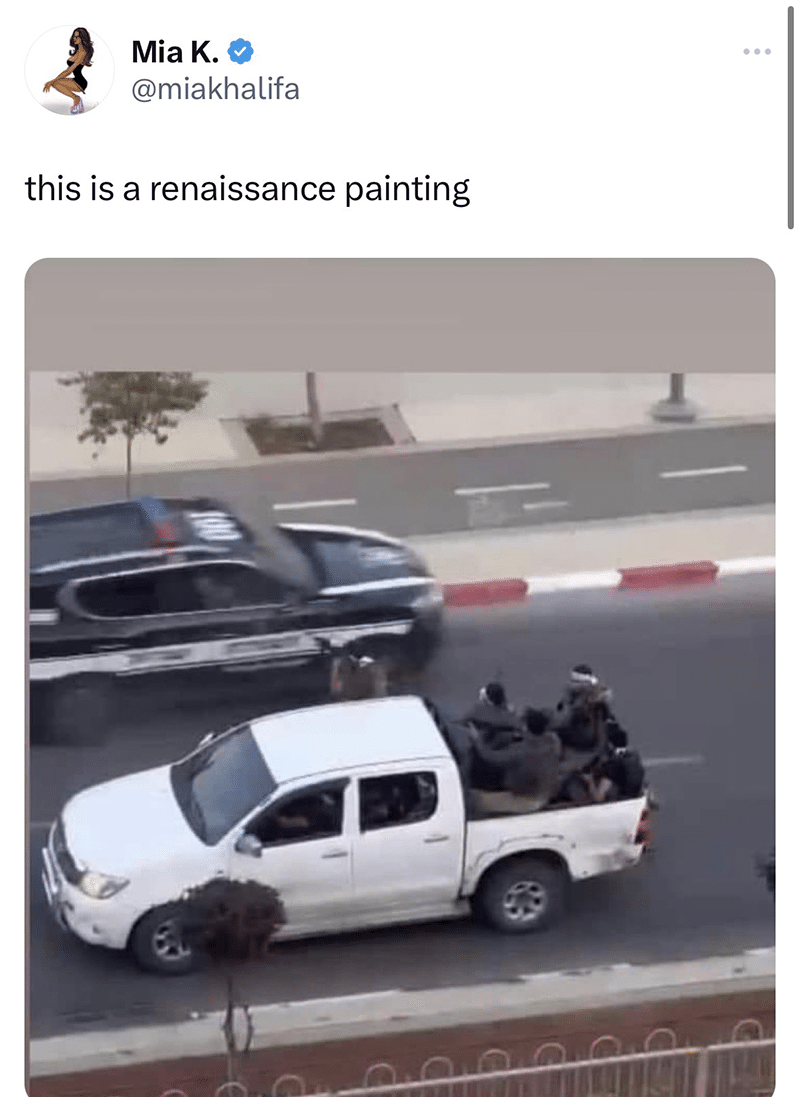
Ironically, the New York Times covered this scene and its bloody aftermath.
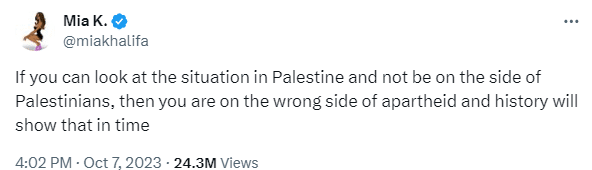
Let’s be clear. Khalifa absolutely supported what Hamas did on October 7:
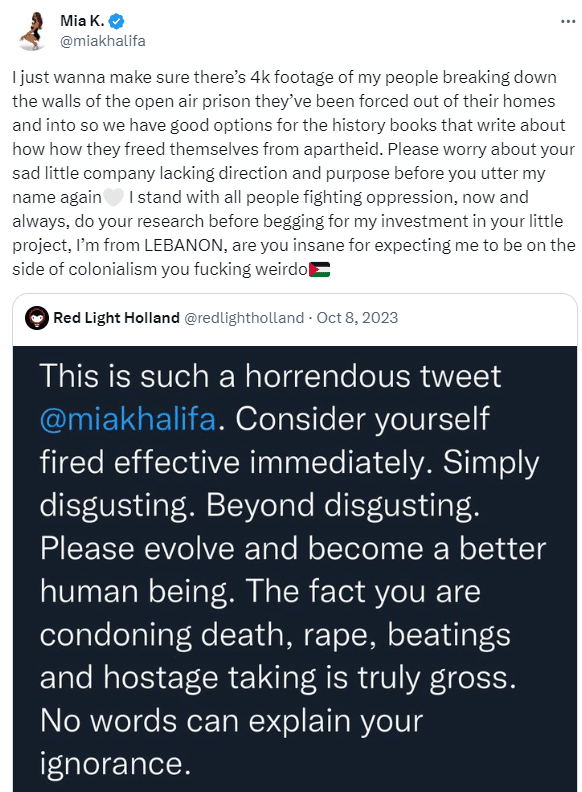
And not just October 7, mind you. As I covered before, in 2014 she posted – under a different name – the wish that Hamas would kill Israeli children:
So I think her intention here is hard to misconstrue.
A proper journalist would have brought all of this up, as well as her antisemitic posts to counter her claim that she is not anti-Jewish. Like the antisemitic blood libels she posted on TikTok (and then deleted). Or this tweet:
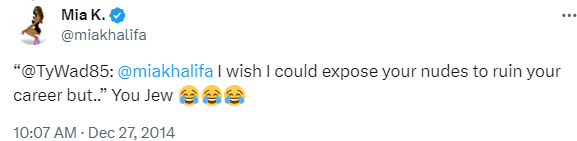
Of course, it would have been better not to platform her at all, but if done, then she should have been held to account.
The question for me is: who is the bigger prostitute: Khalifa or the New York Times?