

In April 1933, at the height of the Nazi regime’s purge of Jewish academics, a brief exchange took place in Göttingen, once one of the world’s foremost centers of mathematical research. The conversation captures in a few stark words the intellectual devastation that follows political fanaticism:
Minister of education: How is mathematics at Göttingen, now that it is free from the Jewish influence?
David Hilbert: There is no mathematics in Göttingen anymore.
(Source of the story: Reid, Constance. Hilbert: With an Appreciation of Hilbert’s Mathematical Work by Hermann Weyl. Vol. 1970. New York-Heidelberg: Springer-Verlag, 1970.)
What we are witnessing in parts of the Western academic world today bears a deeply troubling resemblance to past eras of academic exclusion. Today, a concerted effort is underway to normalize historical prejudices by cloaking them in the contemporary terminology of geopolitical activism. While proponents of academic boycotts routinely argue they are only targeting state institutions, the practical reality frequently results in the ostracism of Israeli mathematicians and mathematically gifted Israeli students: individuals whose participation becomes contested primarily due to their national origin. This environment reveals an academic culture seemingly willing to abandon its professed principles of universality, fairness, and intellectual openness. The eagerness with which some university professors participate in this systemic exclusion is, to many observers, a profound moral failure. By reenacting these patterns of discrimination, this environment establishes a climate where scholarship and integrity are subordinated to political conformity. This article is a call to resist that encroaching segregation within the mathematical community.
The Imposition of the Institutional Loyalty Test

The first sign of organized segregation is the attempt to make basic professional participation contingent upon political alignment. This transforms the international research ecosystem into a venue for ideological vetting. Activists introduce petitions demanding that academic partnerships be severed unless the targeted institutions issue specific, state-condemning political statements. The practical objective appears to be the creation of a binary environment where targeted scholars must navigate institutional renunciation or face professional isolation.
In our view, the Mathematicians Against the Genocide in Gaza petition seeks to institutionalize a form of “loyalty test” within the scientific community. The petition states:
“We urge our colleagues to cease all scientific collaboration with Israeli institutions that do not explicitly condemn the genocide in Gaza and the illegal colonization of Palestine.”
This demand relies on the heavily debated assertion that a genocide is occurring in Gaza, a characterization that numerous legal scholars and commentators strongly dispute. (For example, see Gregory Lyakhov, Israel-Gaza Conflict: Debunking Genocide Claims, Times of Israel, Nov 25, 2024.)
Financial Asphyxiation via “Conscientious Objection”
Beyond symbolic protests, these campaigns frequently evolve into targeted financial obstruction, deploying decentralized strategies that inflict measurable harm on the broader scientific ecosystem. Coordinated campaigns often pressure international organizations to sever research and development funding for the targeted state, depriving the affected academic community of the resources essential to sustaining research activity.
The European Declaration of Conscientious Objection exemplifies this dynamic. The declaration urges employees in higher education to terminate bilateral agreements with Israeli institutions. One of its central, stated aims is the suspension of the EU-Israel Association Agreement, a step that would jeopardize more than €2.12 billion in Horizon Europe research funding allocated to Israeli entities.
The Erasure of Youth and National Identity
To secure long-term systemic exclusion, activist movements often focus on the next generation, attempting to normalize the perception of the targeted group as a “pariah state” in the minds of the world’s youth. This includes lobbying international student competitions to strip targeted youth of their national affiliation.
A prominent example is the campaign Mathematics and Moral Responsibility: The IMO and the Genocide in Gaza led by AURDIP, supported by an open letter with over 700 reported signatories. By lobbying the International Mathematical Olympiad (IMO) to formally suspend Israel, proposing that Israeli youth only compete as private individuals without national flags, this campaign attempts to politicize one of the few remaining venues for neutral international competition.
The Ideological Capture of the Digital Commons
The ideological capture of a scientific discipline does not happen all at once; it begins with the gradual erosion of professional boundaries in the digital spaces used for daily collaboration. Digital commons risk being transformed from neutral marketplaces of ideas into broadcasting networks for asymmetric geopolitical warfare.
The Category Theory Zulip archive exemplifies this phenomenon, having hosted discussions that mobilize support for political actions like the Global Sumud Flotilla. As the archives show, when peers advocate for a return to professional neutrality or question the premises of activist statements, they are often met with resistance that frames geopolitical stances as undeniable moral imperatives.
The Weaponization of Humanitarian Frameworks
Organized exclusion relies on a heavy legal and moral veneer to justify actions that, in other contexts, would be widely recognized as discriminatory. This involves the co-opting of international legal frameworks and highly emotive terminology to mobilize the scientific community.
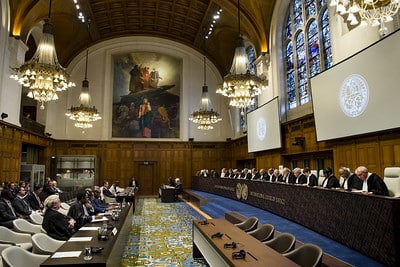
Activists heavily utilize the emotive narrative of ‘scholasticide’ and frequently leverage the July 2024 advisory opinion of the International Court of Justice (ICJ) to demand the severing of academic ties. However, critics of these boycotts point out that the ICJ opinion does not explicitly mandate a boycott of individual research or academic cooperation, making the activists’ expansive interpretation a political choice rather than a legal requirement.
A Necessary Note on Elite Complicity
Movements of this nature heavily rely on the professional prestige of their purported signatories to pressure junior researchers into conformity. Petitions often boast the names of Fields Medalists and high-ranking administrators. However, it is vital to critically examine these campaigns: one must question whether all of these high-profile academics fully endorse the specific, exclusionary consequences of these mechanisms in practice, or if the prestige of their names is being leveraged to legitimize a broader climate of ostracism that harms individual scholars and students simply because of their nationality.
Conclusion
We see familiar shadows lengthening over the lecture halls of the West today. While modern campaigns insist their targets are strictly institutional, their practical effect revives the spirit of the loyalty test, forcing academics to navigate extreme political hostilities simply to participate in their fields. We must refuse to participate in this regression. When Israelis are stripped of their national flags at youth competitions and pressured into professional isolation, it is the Western academy itself that loses its moral compass. We must understand that the segregation of Israelis in academia is not a pathway to justice, but a deeply misguided effort that ultimately betrays the foundational openness of the scientific community.
Note on Methodology and Intent
This essay relies on publicly available documents, organizational statements, and open forum archives (reproduced here under fair use principles) to analyze current trends in the academic community. The conclusions drawn represent my professional and moral perspective on the consequences of these coordinated actions. My intent is to foster discussion about the nature of academic freedom, not to make factual allegations regarding the personal intent or character of any specific individuals involved in these movements.